


Your shopping cart is empty!
Dill "Goldkrone"
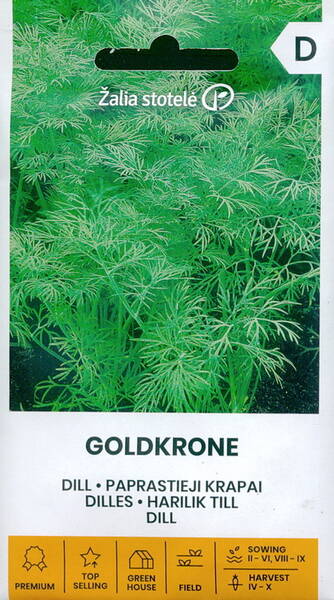

Dill "Goldkrone".
Abundantly leafy variety with intensive growth. The leaf is dark green, very aromatic.
Advantages of the variety: forms inflorescences late, resistant to lack of light.
Recommended for growing for greens.
Sowing seeds into the ground is carried out in late April - early May.
How many seeds are in 1 gram of dill: 1.0 g = 590-650 pieces.
Abundantly leafy variety with intensive growth. The leaf is dark green, very aromatic.
Advantages of the variety: forms inflorescences late, resistant to lack of light.
Recommended for growing for greens.
Sowing seeds into the ground is carried out in late April - early May.
How many seeds are in 1 gram of dill: 1.0 g = 590-650 pieces.
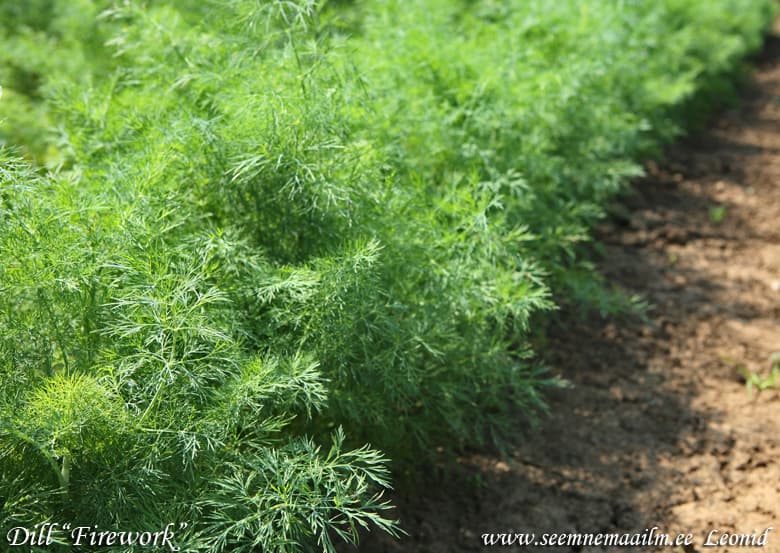
* Preparing dill seeds for sowing.
Seeds are soaked in a damp cloth for 2-3 days before sowing, then, after 20 minutes of drying, they are sown into damp furrows.
Other methods of seed preparation are also practiced. For example, before sowing, they are soaked in water with the addition of urea (1/2 teaspoon of fertilizer per 1 liter). The seeds are kept in this solution for a day, then placed in a damp bag and kept for another 3 days. After that, they are slightly dried to a free-flowing state and proceed to sowing.
Good results are obtained by soaking dill seeds in mushroom infusion. To do this, take 25 g of waste from dried mushrooms, grind and pour 200 g of water. After a day, strain and soak dill seeds in the infusion for 6 hours.
Preparing the site and sowing seeds into the ground.
Dill is a fairly cold-resistant plant. The greatest demand for heat is manifested in it during the period of flowering and seed formation. Very demanding on moisture, but its excess negatively affects the yield and essential oil content. It is advisable to place dill in illuminated areas with cultivated soils rich in humus and fertilized with mineral fertilizers. High yields of greens are obtained on light fertile soils.
Dill grows well when sown before winter. In spring, dill is sown very early, as soon as the snow melts. The bed for dill is prepared in the fall. It is dug to a depth of 20-25 cm, with the addition of 2-3 kg of humus, a tablespoon of ready-made garden mixture and a glass of wood ash per 1 sq. m. In spring, the bed is leveled and furrows are made with a distance of 20 cm and a depth of 2-3 cm.
In spring, dill seeds are either sown among other vegetables, or (approximately in the second half of April) sown separately in rows, spaced 25 cm apart. The seeding rate is 2 g/m2, the sowing pattern is 20x5 cm, the depth is 0.5 cm.
After sowing, the soil is slightly compacted and carefully watered from above, sprinkled with a layer of 0.3 cm of sifted peat or humus. It is a good idea to cover the bed with film before germination, raising it 3-5 cm above the bed. With this method of sowing, dill gives friendly dark green shoots. To have fresh dill greens during the summer, it can be sown every 15 days from April to August.
Dill is also sown in autumn before winter, November 15-20, when the soil freezes, but the beds must be prepared before frost. With this sowing, dill greens are obtained in spring approximately 10-15 days earlier than with spring sowing.
Care, watering and feeding.
After the emergence of seedlings, the plants are thinned out, leaving a distance of 10 cm between them, and used for greens, and the remaining plants are grown for pickling and for seeds.
Dill is watered once a week at the rate of 5-18 liters per 1 sq. m, depending on the weather, or 2 times a week at 6-7 liters per 1 sq. m. Dill can be fed with a solution of organic fertilizers. Dilute 0.5 liters of cow manure in 10 liters of water, strain the solution and feed the plants at the rate of 5 liters per 1 sq. m.
Dill is an early-ripening plant (greens are ready 30-40 days after sowing). Attention! With a long day, the plants bloom quite quickly. To shorten the day, the bed is covered with an opaque material. Dill grows and develops well with a day length of 12 hours.
Harvesting.
Dill as greens is harvested at a young age, when the stem and leaves are juicy, reaching 15-25 cm in height (this is approximately on the 50-60th day after sowing). To use dill for marinades and canning, it is harvested after flowering, during the period of seed setting (August-September). At this time, seeds and flower stalks contain the maximum amount of essential oil. Attention! Ripe seeds quickly crumble.
Obtaining your own seeds.
To obtain greens, dill can be sown in several terms, but for seeds - only late in autumn or early in spring, as soon as the soil is ready. Pre-sowing soil treatment includes the application of 10-20 g of ammonium nitrate and 10-15 g of superphosphate and potassium salt per 1 sq. m.
With winter sowing, dill seedlings appear already in April, flowering compared to early spring sowing begins 10-20 days earlier. Dill is sown in a row method with row spacing of 30-45 cm, the depth of sowing seeds is 0.5 cm. The seeding rate is 1-1.5 g per 1 sq. m.
With winter sowing, the rows are mulched with peat or humus (but not manure) with a layer of 1-1.5 cm.
In the phase of 3-4 leaves, the plants are thinned out, leaving a distance of 8-10 cm between them in the row. With thickened sowing or in a shaded place, the plant is very elongated, turns yellow, quickly throws out a flower stalk, but the seeds are defective.
Care for crops consists in carrying out 2-3 loosening, watering and, if necessary, 1-2 top dressings, as well as removing weeds. On infertile soils, the first top dressing is carried out immediately after thinning, using a solution of mineral fertilizers at the rate of 15-20 g of ammonium nitrate, 20-40 g of superphosphate and 10-20 g of potassium salt per 1 sq. m. The second top dressing is carried out before flowering at the rate of 29-40 g of superphosphate and 15-20 g of potassium salt per 1 sq. m.
Dill is pollinated by insects. To preserve the varietal qualities of seeds, cross-pollination of flowers of seed plants with plants of other varieties should not be allowed.
In the conditions of a garden plot, this is done as follows: before the beginning of flowering, pegs are placed near the seed plants 3-5 cm longer than the plants, to which they are tied. Pieces of gauze are thrown over the pegs and umbrellas, the ends of the gauze are pulled together with a rope at the bottom, the inflorescence is in a bag. For better pollination of flowers, a fly or bee is placed in the bag.
Seeds usually ripen in August. Harvesting begins when 60-70% of the seeds in the umbrellas acquire a brown color. Peduncles are cut and dried in the shade, threshed and sorted. The yield of dill seeds from 1 sq. m is approximately 40-60 g. Germination of well-ripened seeds is 75-80%. The mass of 1000 seeds is 1.8-2.0 g. Seeds are stored in bags or paper bags in room conditions. Dill seeds retain germination for 2-3 years.
Dill diseases and measures to combat them.
Cercosporosis. Light green and yellow spots form on